|

Custom Search
|
 Pet
Pet Is Fish a Sustainable Ingredient for Pet Food?
There's continual arguement over the use of fish as a sustainable crop for human food consumption, given the perilous state of current fish stocks. This also has an impact on whether fish should be promoted as a sustainable ingredient in pet food. n.b. Fishmeal, which is the usual fish ingredient within pet food, is a commercial product made from both whole fish and the bones and offal from processed fish. It is a brown powder or cake obtained by rendering pressing the whole fish or fish trimmings to remove the fish oil. (for more on this see below) The World Wildlife Fund states 'More than 70% of the world’s commercial marine fish stocks are either fully exploited or overfished. Unsustainable fishing - caused by poor fisheries management and wasteful, destructive fishing practices - is decimating the world's fisheries, as well as destroying marine habitats and killing billions of unwanted fish and other marine animals each year. As a result, the future of the fishing industry is under threat - as are already endangered marine species and habitats, and the livelihoods and food security of millions of people.' Getting independent and reliable information is always difficult in these situations, because national governments have a vested interest in promoting their own cause - Iceland is a case in point, a country which insists that its fishing is sustainable, and yet the Swiss retail industry sent shock waves through the Icelandic fishing industry in 2008 when three of its largest supermarkets announced they would no longer sell wild caught cod from that country. The best source of information seems to be the Marine Conservation Society, which has produced and excellent resource where you can check up on varieties of fish and find out information on whether or not stocks are vulnerable, and if you are able to choose, from which countries to buy fish. (view their website) The MSC state the problem facing the fishing industry quite bluntly
CodThe MCS has this advice about cod - "There are three commercially exploited cod species - Atlantic, Pacific and Greenland. All North East Atlantic cod stocks are assessed as being overfished, however stocks in the North Sea, Irish Sea, West of Scotland, eastern Channel, eastern Baltic, Greenland, Skaggerak, Kattegat and Norwegian coast are the most heavily depleted. North East Arctic (Barents and Norwegian Sea), Icelandic and Faroese cod and the combined stock in ICES Area V11e-k are healthier. However, ICES recommends that fishing pressure on these stocks also be reduced. Farming of Atlantic cod is a more recent development. Where available choose cod from farms that have Organic certification. Pacific cod is generally more abundant than Atlantic stocks. The Bering Sea and Aleutian Islands Freezer Longline Fishery was certified as an environmentally responsible fishery by the Marine Stewardship Council in 2006. Information on the stock status of Greenland cod is incomplete at present.." Herring
In European waters, herring is managed by a system of Total Allowable Catches and quotas. Drift net fisheries in Thames Blackwater and the Eastern English Channel are certified as environmentally responsible fisheries by the Marine Stewardship Council (MSC). In May 2006 a fishery in the North Sea and Eastern English Channel autumn-spawning stock was also certified as an environmentally responsible fishery by the MSC. In June 2008 MSC certified the Scottish Pelagic Sustainability Group in the North Sea & the Astrid Fiske North Sea fishery as environmentally responsible fisheries.Herring stocks in the Norwegian Sea (spring spawners), Eastern Baltic (subdivision 30) and the Gulf of Riga are also assessed by ICES as being healthy and harvested sustainably." Tuna
All 7 commercially fished species are under pressure and 3 are listed by IUCN - the World Conservation Union: Bigeye assessed as Vulnerable; Northern bluefin assessed as Endangered in the east Atlantic and Critically Endangered in the west Atlantic. Also listed by OSPAR as a threatened and declining species; and Southern bluefin assessed as Critically Endangered. Avoid eating bigeye, northern and southern bluefin tuna.Pacific bluefin also has low resilience to fishing and current rates of fishing are considered unsustainable. Avoid eating. Albacore from the south Atlantic and south Pacific, skipjack and yellowfin from the Pacific and Atlantic and skipjack from the Indian oceans, are currently being fished at sustainable levels. Increase the sustainability of the tuna you eat from these areas by choosing line (pole and line or handline) or troll-caught (where available) \'dolphin-friendly\' fish. For more information on \'dolphin-friendly or safe\' tuna certified by the Earth Island Institute see www.earthisland.org/dolphinSafeTuna. The American Albacore Fishing Association Pacific (North and South) pole and line and troll fishery for Albacore tuna (Thunnus alalunga) is currently undergoing assessment by the Marine Stewardship Council (MSC) as an environmentally responsible fishery. Tuna farming or ranching of southern and northern bluefin relies on capture of juveniles from the wild. Avoid eating." SalmonPacific salmon are a shorter lived species and much more prolific breeders than Atlantic salmon. Stocks of wild Atlantic salmon are overfished and are listed by OSPAR as a threatened and declining species. Atlantic salmon is widely farmed.There are a number of environmental issues related to fish farming. All 5 species of Pacific salmon caught in Alaskan waters are from fisheries certified by the Marine Stewardship Council (MSC) as environmentally responsible fisheries. British Columbia Salmon fishery (Onchorhyncus sp) is currently undergoing assessment by the MSC as an environmentally responsible fishery. California Chinook troll-fishery is also undergoing assessment by MSC. Choose wild caught Pacific salmon from MSC certified fisheries or farmed Atlantic salmon which has been certified by the Soil Association as organic, and/or by the RSPCA/SSPCA Freedom Foods scheme ensuring that high environmental and welfare standards have been met.
ConclusionsAt the end of the day the consumer has to make up his of her mind as to the ethics of the current fishing situation. Organisations such as the MSC and the WWF are trying hard to pull governments together to get a sustainable policy that will work.
More on Fish MealTwo basic types of fish meal are produced for use in food manufacture; 1) produced from fishery waste (salmon, tuna, etc.) that are associated with the processing of various edible human fishery products and 2) when specific fish (herring, menhaden, pollack, etc.) are harvested just for the purpose to produce fish meal. The fish can be dried directly drying or cooking prior to drying and oil extracted. In addition to being a by-product of human fish production it is also a by-product associated with fish oil production. In some parts of the world it is often the primary supplemental protein source that is feed to livestock, because plant derived sources are either unavailable or are to expensive. The lipids associated with fish are highly unsaturated and highly susceptible to be oxidized. Amino acid quality of fish is excellent, but excessive heating during the drying process can reduce digestibility of the protein fraction and complex some of the amino acids, so that they are not available. Fish meal is often used as a by-pass protein source for feeding applications for lactating dairy cattle. Composition (CP, Ash, EE, etc.) of fish meal can vary depending upon what substrate and the method being used to prepare the meal. If fish that have been allowed to degrade prior to being processed are used in preparing fish meal, then the resultant fish meal will be of lower quality. Fish meal that has been produced from materials that has been allow to degrade prior to being processed can contain high levels of histamines and can be toxic (AGRIS 93-031733) (Yuningsih, 1988). Elevated histamine levels (1000 ppm) can cause gizzard erosion and black vomit in poultry (AGRIS 93-031733) (Yuningsih, 1988). Care should be taken to assure that the fish meal being used has not been contaminated with harmful substances (chlorinated hydrocarbons, dieldren, lindane, PCBs, etc.) that have been found in fish meals in the past (AGRIS 80-554085) (Erne, 1979). Freshness of fish being processed into fish meal is highly correlated with the quality of the resultant fish meal (AGRIS 81-630691) (Bon, 1980). The oils associated with fish meal contain highly unsaturated and are oxidizes easily. Storing of fish meal is dependent upon the oil content of the meal and how it has been stabilized with antioxidants (AGRIS 1999-085040) (Wilairat-Jaroenjit, 1996)
|
|
||||||||||||||
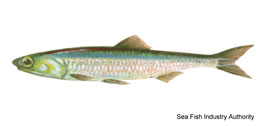
 Herring
aften find their way into fish meal. The MSC say "The largest
single fishery is for Atlantic herring which is fished throughout
much of the North Atlantic.
Herring
aften find their way into fish meal. The MSC say "The largest
single fishery is for Atlantic herring which is fished throughout
much of the North Atlantic. 


©2008Pet Food Choice - All information on this website is given in good faith, but decisions about the feeding requirements of your pets are entirely up to you, or if necessary should be taken with the help and advice of your veterinary surgeon... Site map - see also www.gardening-year.co.uk ,www.dog-food-review.co.uk , www.the-food-lover.co.uk, www.gift-of-flowers.co.uk

